University of Southampton
New evidence showing the level of atmospheric CO2 millions of years ago supports recent climate change predications from the Intergovernmental Panel on Climate Change (IPCC).
A multinational research team, led by scientists at the University of Southampton, has analysed new records showing the CO2 content of the Earth’s atmosphere between 2.3 to 3.3 million years ago, over the Pliocene.
During the Pliocene, the Earth was around 2ºC warmer than it is today and atmospheric CO2 levels were around 350-400 parts per million (ppm), similar to the levels reached in recent years.
By studying the relationship between CO2 levels and climate change during a warmer period in Earth’s history, the scientists have been able to estimate how the climate will respond to increasing levels of carbon dioxide, a parameter known as ‘climate sensitivity’.
The findings, which have been published in Nature, also show how climate sensitivity can vary over the long term.
“Today the Earth is still adjusting to the recent rapid rise of CO2 caused by human activities, whereas the longer-term Pliocene records document the full response of CO2-related warming,” says Southampton’s Dr Gavin Foster, co-author of the study.
“Our estimates of climate sensitivity lie well within the range of 1.5 to 4.5ºC increase per CO2 doubling summarised in the latest IPCC report. This suggests that the research community has a sound understanding of what the climate will be like as we move toward a Pliocene-like warmer future caused by human greenhouse gas emissions.”
Lead author of the study, Dr Miguel Martínez-Botí, also from Southampton said: “Our new records also reveal an important change at around 2.8 million years ago, when levels rapidly dropped to values of about 280 ppm, similar to those seen before the industrial revolution. This caused a dramatic global cooling that initiated the ice-age cycles that have dominated Earth’s climate ever since.”
The research team also assessed whether climate sensitivity was different in warmer times, like the Pliocene, than in colder times, like the glacial cycles of the last 800,000 years.
Professor Eelco Rohling of The Australian National University in Canberra says: “We find that climate change in response to CO2 change in the warmer period was around half that of the colder period. We determine that this difference is driven by the growth and retreat of large continental ice sheets that are present in the cold ice-age climates; these ice sheets reflect a lot of sunlight and their growth consequently amplifies the impact of CO2 changes.”
Professor Richard Pancost from the University of Bristol Cabot Institute, added: “When we account for the influence of the ice sheets, we confirm that the Earth’s climate changed with a similar sensitivity to overall forcing during both warmer and colder climates.”
###
Notes for editors
1. The paper Plio-Pleistocene climate sensitivity from a new high-resolution CO2 record by M.A. Martínez-Botí, G.L. Foster, T. B. Chalk, E.J. Rohling, P.F. Sexton, D.J. Lunt, R.D. Pancost, M.P.S. Badger, D.N. Schmidt is available from Media Relations on request. Please contact Steven Williams, Tel: 023 8059 2128, email: [email protected]
2. Ocean and Earth Sciences at the University of Southampton has a well-established reputation for outstanding research and teaching. Our unique waterfront campus at the National Oceanography Centre, Southampton attracts prominent researchers and educators from around the world, who join us to work within the areas of geochemistry, geology and geophysics, ocean biodiversity, geochemistry and ecosystems, physical oceanography, palaeoceanography and palaeoclimate, and coastal and shelf seas.
Through degree programmes in oceanography, marine biology, geology and geophysics, our students have access to ships, ocean technology and opportunities for fieldwork and scientific cruises not traditionally found in standard university environments. http://www.
3. Through world-leading research and enterprise activities, the University of Southampton connects with businesses to create real-world solutions to global issues. Through its educational offering, it works with partners around the world to offer relevant, flexible education, which trains students for jobs not even thought of. This connectivity is what sets Southampton apart from the rest; we make connections and change the world.
http://www.
#weareconnected
4. The National Oceanography Centre (NOC) is the UK’s leading institution for integrated coastal and deep ocean research. NOC operates the Royal Research Ships James Cook and Discovery and develops technology for coastal and deep ocean research. Working with its partners NOC provides long-term marine science capability including: sustained ocean observing, mapping and surveying, data management and scientific advice. NOC operates at two sites, Southampton and Liverpool, with the headquarters based in Southampton.
Among the resources that NOC provides on behalf of the UK are the British Oceanographic Data Centre (BODC), the Marine Autonomous and Robotic Systems (MARS) facility, the National Tide and Sea Level Facility (NTSLF), the Permanent Service for Mean Sea Level (PSMSL) and British Ocean Sediment Core Research Facility (BOSCORF). The National Oceanography Centre is wholly owned by the Natural Environment Research Council (NERC).
For further information contact:
Steven Williams, Media Relations, University of Southampton, Tel: 023 8059 2128, email: [email protected]
http://www.
Follow us on twitter: http://twitter.
Like us on Facebook: http://www.
Disclaimer: AAAS and EurekAlert! are not responsible for the accuracy of news releases posted to EurekAlert! by contributing institutions or for the use of any information through the EurekAlert system.
]]>
Researchers from the University of Southampton, the National Oceanography Centre and the Australian National University developed a new method for determining sea-level and deep-sea temperature variability over the past 5.3 million years. It provides new insight into the climatic relationships that caused the development of major ice-age cycles during the past two million years.
The researchers found, for the first time, that the long-term trends in cooling and continental ice-volume cycles over the past 5.3 million years were not the same. In fact, for temperature the major step toward the ice ages that have characterised the past two to three million years was a cooling event at 2.7 million years ago, but for ice-volume the crucial step was the development of the first intense ice age at around 2.15 million years ago. Before these results, these were thought to have occurred together at about 2.5 million years ago.
The results are published in the scientific journal Nature.
Starting An Ice Age
Co-author Dr Gavin Foster, from Ocean and Earth Science at the University of Southampton, says: “Our work focused on the discovery of new relationships within the natural Earth system. In that sense, the observed decoupling of temperature and ice-volume changes provides crucial new information for our understanding of how the ice ages developed.
“However, there are wider implications too. For example, a more refined sea-level record over millions of years is commercially interesting because it allows a better understanding of coastal sediment sequences that are relevant to the petroleum industry. Our record is also of interest to climate policy developments, because it opens the door to detailed comparisons between past atmospheric CO2 concentrations, global temperatures, and sea levels, which has enormous value to long-term future climate projections.”
The team used records of oxygen isotope ratios (which provide a record of ancient water temperature) from microscopic plankton fossils recovered from the Mediterranean Sea, spanning the last 5.3 million years. This is a particularly useful region because the oxygen isotopic composition of the seawater is largely determined by the flow of water through the Strait of Gibraltar, which in turn is sensitive to changes in global sea level — in a way like the pinching of a hosepipe.
As continental ice sheets grew during the ice ages, flow through the Strait of Gibraltar was reduced, causing measurable increases in the oxygen isotope O-18 (8 protons and 10 neutrons) relative to O-16 (8 protons and 8 neutrons) in Mediterranean waters, which became preserved in the shells of the ancient plankton. Using long drill cores and uplifted sections of sea-floor sediments, previous work had analysed such microfossil-based oxygen isotope records from carefully dated sequences.
The current study added a numerical model for calculating water exchange through the Strait of Gibraltar as a function of sea-level change, which allowed the microfossil records to be used as a sensitive recorder of global sea-level changes. The new sea-level record was then used in combination with existing deep-sea oxygen isotope records from the open ocean, to work out deep-sea temperature changes.
Lead author, Professor Eelco Rohling of Australian National University, says: “This is the first step for reconstructions from the Mediterranean records. Our previous work has developed and refined this technique for Red Sea records, but in that location it is restricted to the last half a million years because there are no longer drill cores. In the Mediterranean, we could take it down all the way to 5.3 million years ago. There are uncertainties involved, so we included wide-ranging assessments of these, as well as pointers to the most promising avenues for improvement. This work lays the foundation for a concentrated effort toward refining and improving the new sea-level record.”
Noting the importance of the Strait of Gibraltar to the analysis, co-author Dr Mark Tamisiea from the National Oceanography Centre, Southampton adds: “Flow through the Strait will depend not only on the ocean’s volume, but also on how the land in the region moves up and down in response to the changing water levels. We use a global model of changes in the ocean and the ice sheets to estimate the deformation and gravity changes in the region, and how that will affect our estimate of global sea-level change.”
Journal Reference:
- E. J. Rohling, G. L. Foster, K. M. Grant, G. Marino, A. P. Roberts, M. E. Tamisiea, F. Williams. Sea-level and deep-sea-temperature variability over the past 5.3 million years. Nature, 2014; DOI: 10.1038/nature13230
]]>
The Summer School is aimed at graduate students and early career postdoctoral researchers, primarily the ones involved in sponsors’ projects, namely the 973 Coevolution Project of Chinese Ministry of Science and Technology, Nanjing State Key Laboratory of Palaeobiology and Stratigraphy and NERC “Life and the Planet” Research Programme. But enquires by those outside the programme/projects are also welcome.
The purpose of the Summer School is to provide students with an overview of state-of-the-art and hands-on palaeoenvironmental research. Course tutors are all senior researchers working actively in various earth science disciplines from the UK and China.
The 2014 School lasts in total 7 days. Day 1 and Day 4-7 will be held at the Nanjing Institute of Geology and Palaeontology, Day 2-3 a short field trip will be carried out near Nanjing. Read the outline for the course here
]]>
Figure 1: Compilation of available CO2 data for the last 450 million years. For data sources see text. Proxy records are colour coded and labelled in the relevant panel. Greenhouse gas emission scenarios (RCP – Representative Concentration Pathways) used in IPCC AR5 are shown in the right hand panel. Note the variable log scale for time. For the geological data a smoothed line has been fit to the data with an uncertainty accounting for uncertainty in age and CO2. The black line describes the most probable long-term CO2 with 68% confidence limits in red, and 95% confidence in pink.
Carbon dioxide (CO2) in the Earth’s atmosphere is a potent greenhouse gas, responsible for trapping longwave radiation and ensuring the habitability of our planet. Variations in its concentration are thought to be important for controlling the evolution of the Earth’s climate on geological timescales (hundreds of thousands to millions of years) and recent anthropogenic increases in atmospheric CO2 have played a major role in more recent global warming. Read more here.
Reconstructing atmospheric CO2 in the past is a tricky business. For the last 800 thousand years we have bubbles of ancient atmosphere trapped in ice that can be recovered from Antarctica. Prior to this time we have to rely on more indirect methods also known as proxies. Those available to us are discussed in detail in the latest IPCC report, and in particular in Table 5.A.2 in Chapter 5 “Information from Paleoclimate Archives” and more briefly here.
In the Figure 1, we have plotted all the available pre-ice core CO2 reconstructions for the last 423 million years (a total of nearly 800 data points) and compared them to more recent records and projections for the future. The palaeo-CO2 data can be found here, the ice core data here & here , historical data here and the projections of CO2 for the future here.
For the ancient CO2 data there is an increased variability due to the existence of both real short term variability (e.g. orbitally driven change like the well-known glacial-interglacial cycles) and increased noise due to the uncertainty in CO2 reconstructed by these more indirect methods. To account for this and to better reveal the long-term trends in the CO2 data we have fitted a smoothed curve, which has an uncertainty due to the uncertainty on the age and CO2 of each data point. This smoothed curve can be found here (Phanerozoic-CO2). This treatment reveals a number of interesting features:
- Despite considerable variability, there has been a gradual long term decline in CO2 over the last 450 million years or so. On average this is around 13 ppm (parts per million) per million years.
- Values similar to today (398.03 ppm for Feb 2014) were last seen during short intervals in the Pliocene some 3 to 5 million years ago, but the last time long-term mean CO2 was at this level was in the middle Miocene climatic optimum (~16 million years ago; see this blog piece by Paul Pearson for more discussion).
- For much of the rest of the last 450 million years or so Earth generally had higher CO2 than today (with the exception of the Carboniferous-Permian ~300 million years ago where CO2 was once again similar to today).
- Business as usual emission scenarios (RCP8.5 on the figures) indicate atmospheric CO2 will reach around 1000 ppm by around 2110 AD (less than 100 years’ time). The last time CO2 was this high was during the early Eocene Climatic Optimum (EECO)– the warmest time period of the last 50 million years. The planet was so warm during the period that it was completely ice free (sea-level +65 m or so relative to today) and the latest compilations put global temperatures +13 ± 2.6 oC warmer than today (Cabellero and Huber, 2013). It is important to note though that around 5 oC of this warming was due to changes in continental configuration, vegetation and the loss of the continental ice sheets.
- Business as usual emission scenarios (RCP8.5) indicate atmospheric CO2 will reach around 2000 ppm by around 2250 AD. The last time long-term CO2 was at this level was 200 million years ago at the Triassic-Jurassic boundary when CO2 was elevated by the massive outpourings of lava (covering an area of 11 million km2) as the supercontinent Pangaea broke apart and the Southern Atlantic opened for the first time, Read more here.
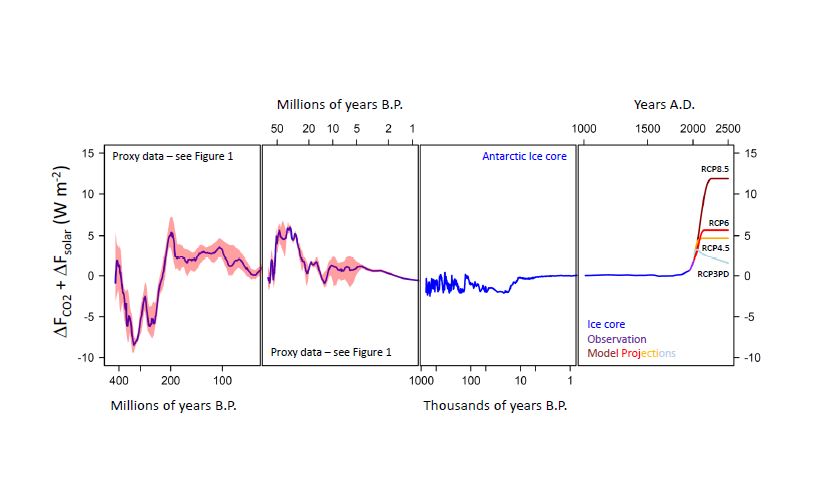
Figure 2: Climate forcing by changing CO2 and solar output for the last 450 million years. CO2 data and projections are as outlined in Figure 1. Changing solar output calculated as described in Gough et al. (1981; Solar Physics, 74, 21-34) with CO2 forcing from Byrne and Goldblatt (2014; doi: 10.1002/2013GL058456). The red band is the 95% confidence interval around the smoothed line through the published CO2 data.
However, the evolution of climate over this time period is not only being forced by changing CO2. As well as tectonics changing the position of the continents, and changes in vegetation and ice changing Earth’s albedo (its reflectiveness) through time (http://www.scotese.com/), models of stellar evolution predict that the output of our Sun has increased over its life time. On relatively short geological timescales (e.g. the last 5 million years or so) this effect is not significant. But over 400 million years the output of the sun has increased by around 4% (equivalent to ~12 W m-2 of climate forcing). We calculated the climate forcing by CO2 (in W m-2) and the Sun for the last 400 million years (using doi: 10.1002/2013GL058456; see Figure 2).
What is revealed is that despite a dramatic change in solar output, the combined climate forcing by CO2 and the Sun has remained relatively constant (Figure 2). This has been commented on before (here) and is likely due to the operation of a strong negative feedback process changing CO2 levels on geological timescales as a function of global temperature (silicate weathering – more here). However we see that with the latest treatment of the proxy data forcing has remained even more tightly constrained (within ± 5 W m-2) over the last 400 million years (Figure 2). Given this longer term view of climate forcing, the scenarios for future fossil fuel use stand out as being even more extreme, and the business as usual scenario (RCP8.5) would amount to a climate forcing by CO2 that is largely unprecedented in the geological record (as far as we can tell).
Members of the Descent into the Icehouse project are working to improve our estimates of CO2 during the EECO. It is important to note that winding the clock back to EECO CO2 levels in the coming century will not result in a simple return to the Eocene climate. Understanding what drove the evolution of the Eocene climate however will aid our wider understanding of the Earth’s climate system and how it behaves in warm climate states.
]]>
Co-evolution of Life and the Planet conference in UCL and Geological Society London
The Earth that sustains us today has arisen out of planetary scale co-evolution of the physical and biological worlds. The complexity of these interactions necessitates a multidisciplinary ‘Earth System Science’ approach. Two years on from ‘Life and the Planet 2011’, this two-day meeting will explore advances in our understanding of the coupled evolution of life and the planet.
The four main themes of this meeting are:
1) Precambrian origins of the modern Earth System;
2) Key events in the evolution of marine ecosystems;
3) Geological constraints on biological evolution in the polar regions;
4) Descent into the Icehouse during the Cenozoic Era.
The registration to the conference is now open! For further information, please click!
]]>Researchers from the University of Southampton and the Australian National University report that sea-level rise since the industrial revolution has been fast by natural standards and – at current rates – may reach 80cm above the modern level by 2100 and 2.5 metres by 2200.
The team used geological evidence of the past few million years to derive a background pattern of natural sea-level rise. This was compared with historical tide-gauge and satellite observations of sea-level change for the ‘global warming’ period, since the industrial revolution. The study, which was funded by the Natural Environment Research Council (iGlass consortium) and Australian Research Council (Laureate Fellowship), is published in the journal Scientific Reports.

Lead author Professor Eelco Rohling, from the Australian National University and formerly of the University of Southampton, says: “Our natural background pattern from geological evidence should not be confused with a model-based prediction. It instead uses data to illustrate how fast sea level might change if only normal, natural processes were at work. There is no speculation about any new mechanisms that might develop due to man-made global warming. Put simply, we consider purely what nature has done before, and therefore could do again.”
Co-author Dr Gavin Foster, a Reader in Ocean and Earth Science at the University of Southampton, who is based at the National Oceanography Centre, Southampton (NOCS), explains: “Geological data showed that sea level would likely rise by nine metres or more as the climate system adjusts to today’s greenhouse effect. But the timescale for this was unclear. So we studied past rates and timescales of sea-level rise, and used these to determine the natural background pattern.”
Co-author Dr Ivan Haigh, lecturer in coastal oceanography at the University of Southampton and also based at NOCS, adds: “Historical observations show a rising sea level from about 1800 as sea water warmed up and melt water from glaciers and ice fields flowed into the oceans. Around 2000, sea level was rising by about three mm per year. That may sound slow, but it produces a significant change over time.”
The natural background pattern allowed the team to see whether recent sea-level changes are exceptional or within the normal range, and whether they are faster, equal, or slower than natural changes.
Professor Rohling concludes: “For the first time, we can see that the modern sea-level rise is quite fast by natural standards. Based on our natural background pattern, only about half the observed sea-level rise would be expected.
“Although fast, the observed rise still is (just) within the ‘natural range’. While we are within this range, our current understanding of ice-mass loss is adequate. Continued monitoring of future sea-level rise will show if and when it goes outside the natural range. If that happens, then this means that our current understanding falls short, potentially with severe consequences.”
]]>“A profoundly altered planet is what our fossil-fuel-driven civilization is creating, a planet where Sandy-scale flooding will become more common and more destructive for the world’s coastal cities. By releasing carbon dioxide and other heat-trapping gases into the atmosphere, we have warmed the Earth by more than a full degree Fahrenheit over the past century and raised sea level by about eight inches. Even if we stopped burning all fossil fuels tomorrow, the existing greenhouse gases would continue to warm the Earth for centuries. We have irreversibly committed future generations to a hotter world and rising seas.
In May the concentration of carbon dioxide in the atmosphere reached 400 parts per million, the highest since three million years ago. Sea levels then may have been as much as 65 feet above today’s; the Northern Hemisphere was largely ice free year-round. It would take centuries for the oceans to reach such catastrophic heights again, and much depends on whether we manage to limit future greenhouse gas emissions. In the short term scientists are still uncertain about how fast and how high seas will rise. Estimates have repeatedly been too conservative.”
“Six years ago the Intergovernmental Panel on Climate Change (IPCC) issued a report predicting a maximum of 23 inches of sea-level rise by the end of this century. ………….. As the IPCC prepares to issue a new report this fall, in which the sea-level forecast is expected to be slightly higher, gaps in ice-sheet science remain. But climate scientists now estimate that Greenland and Antarctica combined have lost on average about 50 cubic miles of ice each year since 1992—roughly 200 billion metric tons of ice annually. Many think sea level will be at least three feet (about 90cm) higher than today by 2100. Even that figure might be too low.”
Folger discusses with engineers, scientists, architects and citizens from New York, Miami, New Orleans and Rotterdam, Netherlands about the factors contributing to sea-level rise and the current projections. One of the scientists being interviewed for the article was Gavin Foster, a geochemist at the National Oceanography Centre, University of Southampton and Principal Investigator of the Descent into the Icehouse Project. Gavin says that
“With business as usual, the concentration of carbon dioxide in the atmosphere will reach around a thousand parts per million by the end of the century. …..Such concentrations haven’t been seen on Earth since the early Eocene epoch, 50 million years ago, when the planet was completely ice free. According to the U.S. Geological Survey, sea level on an iceless Earth would be as much as 216 feet higher than it is today. It might take thousands of years and more than a thousand parts per million to create such a world—but if we burn all the fossil fuels, we will get there.
No matter how much we reduce our greenhouse gas emissions, we’re already locked in to at least several feet of sea-level rise, and perhaps several dozens of feet, as the planet slowly adjusts to the amount of carbon that’s in the atmosphere already. A recent Dutch study predicted that the Netherlands could engineer solutions at a manageable cost to a rise of as much as five meters, or 16 feet. Poorer countries will struggle to adapt to much less. At different times in different places, engineering solutions will no longer suffice. Then the retreat from the coast will begin. In some places there will be no higher ground to retreat to.”
Read the article here
]]>Scientists on the road tried with an easy and fun hands-on activity to explain to students and future scientists Ocean Acidification and its impact on the ocean and sea organisms.

Eleni, Greame and Migue at The Big Bang Near Me event @Bournemouth and Poole
Approximately one quarter of carbon dioxide emitted by humans in the air is absorbed by the ocean. This alters the chemical composition of the sea: a more acidic water threatens the life conditions of organisms whose skeletons or cells are made of calcium carbonate, such as phytoplankton, snails, mussels or, more evident to the human eye, corals. In order to explain children how Ocean Acidification works, we used red cabbage juice, a safe acid/base indicator which reacts in a clear manner to the introduction of CO2 by changing colour.
The star of the show was some red cabbage juice. We poured a very small volume of the cooled juice into test tubes and we asked children to blow through a drinking straw repeatedly for a few minutes until they could see the cabbage juice turn noticeably pinker that the juice in the bottle.
What has happened? The carbon dioxide in the breath combined with the water in the cabbage juice (cabbage is an acid indicator) to form carbonic acid, causing the pH of the solution to drop and the cabbage juice to turn pink.
Why this is interesting? About a quarter of the carbon dioxide released by activities like burning fossils fuels is absorbed by oceans and as a result the ocean water becomes more acidic, like the cabbage juice in the experiment.
Our simple experiment was particularly successful; the children and some of their teachers too, had a lot of fun blowing into the cabbage juice and after the experiment they told us that they now have a better understanding of what ocean acidification is and why it is important.
It was great a experience for us all, as well. The experiment stimulated the imagination of the young students and during the lively discussion afterwards they were able to offer us some out of box thinking and we came up with some rather pioneering ideas and innovative solutions of how to combat ocean acidification.
Participants
Eleni Angnostou Graeme MacGilhrist Migue Martínez-Botí Athena Drakou ]]>Ellen Thomas, currently in Bristol on sabbatical from Yale, and David Armstrong-McKay, from the National Oceanography Centre (NOC), began the morning session with a series of talks devoted to the late Eocene and early Oligocene. Ellen discussed the Eocene-Oligocene transition (34Ma) from both a modern1 and historical2 perspective while David outlined the competing hypothesis put forward to explain the event3. Dierderik Liebrand, also from the NOC, followed this with a talk on late Oligocene and early Miocene (24-19Ma) cyclostratigraphy4. Following lunch, Bridget Wade gave an hour-long seminar on the Eocene-Oligocene boundary (34Ma)5 and the middle Oligocene (24-30Ma)6. Bridget’s talk doubled as a departmental seminar in the School of Geography.
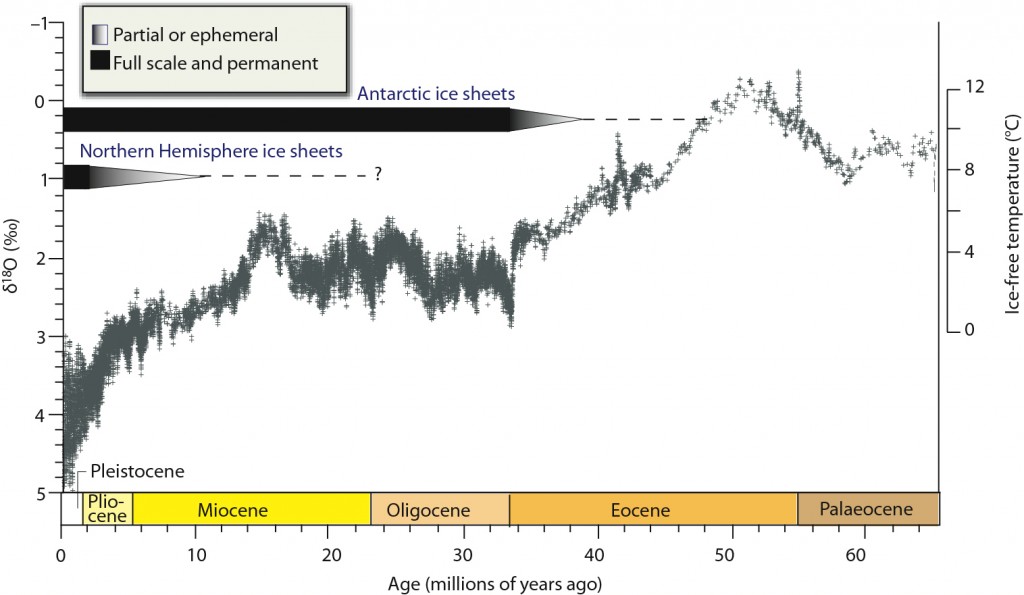
Figure 1: A compilation of benthic foraminifera oxygen isotope values. During the Oligocene, this reflects a combination of ice volume and temperature7
The event was hosted by Gordon Inglis, a PhD student in the School of Chemistry, and was funded by Professor Rich Pancost (Global Change) and Professor Paul Valdes (School of Geography).
————–
For more information, please consult the following references:
- Liu, Z. et al (2009) Global cooling during the Eocene-Oligocene transition: Science, v. 323, p. 1187-1190
- Kennett and Shackleton (1976) Oxygen isotopic evidence for the development of the psychrosphere 38 Myr ago: Nature, v. 260, p. 513-515
- Merico, A, et al. (2008) Eocene/Oligocene ocean de-acidifiation linked to Antarctic glaciation by sea level fall: Nature, v. 452, p. 979-982
- Liebrand, D., et al. (2011) Antarctic ice sheets and oceanographic response to eccentricity forcing during the early Miocene: Climate of the Past, v. 7, p. 869-880
- Wade, B., et al (2011) Multiproxy record of abrupt sea-surface cooling across the Eocene-Oligocene transition in the Gulf of Mexico: Geology, v. 40, p. 159-162
- Wade, B. And Palike, H., (2004) Oligocene climate dynamics: Palaeoceanography, v. 19, PA4019
- Zachos, et al. (2008) An early Cenozoic perspective on greenhouse warming and carbon-cycle dynamics: Nature, v. 451, p. 279-283